
Astronomy For Children
7/16/20253 min read
Astronomy for Children
Once, my friend asked me, “ Both my daughters are interested in stars and planets. One is in first grade and the other is in seventh. How can I nurture their interest?”
My cousin asked me a similar question. Her son is in school, and she wanted to know how both he and she could get started in this subject.
I believe many parents have the same question. So, I felt like writing an article that might answer some of these doubts.
From ancient times, humans have been curious about the planets and stars in the sky. Even today, children in schools find this topic fascinating. When asked “What will you be when you grow up?” along with doctor, engineer, or pilot, some children say, “I’ll be an astronaut.” In truth, they don’t know much about the career itself—what they say often comes from family influence, what they hear, or what they see around them.
Today, with mobile phones, platforms like YouTube are easily accessible. Many children watch videos and learn on their own.
First, children should be told that Astronomy and Space Science are two different subjects.
An astronomer and an astronaut are very different professions, each requiring different qualifications.
Astronomy itself can be divided into two parts:
Theoretical Astronomy and Astrophysics – covering topics like black holes, pulsars, and the structure of stars.
Observational Astronomy – covering activities like sky watching and radio astronomy.
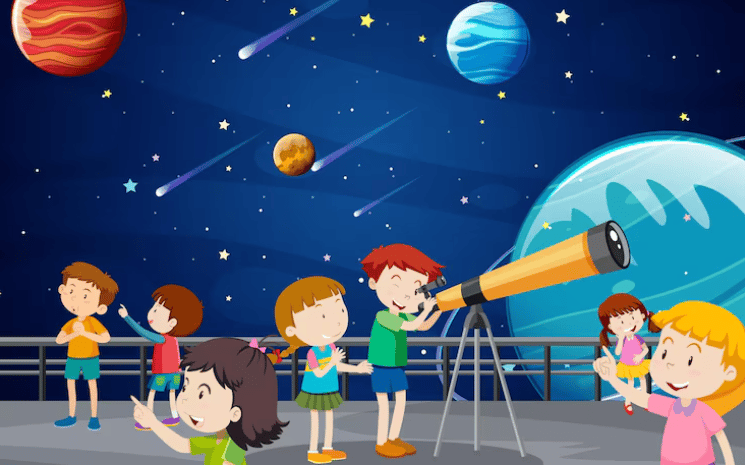
Children usually prefer observational astronomy, where they can use telescopes to see stars, planets, and galaxies.
We can’t strictly divide children into age groups, as they gain new knowledge every year. But broadly, we can think in terms of:
Up to Grade 4
Grades 5 to 7
Grades 8 to 10
When children start showing interest in astronomy, parents often wonder how to nurture it.
Up to Grade 4 (around 9 years old):
Picture books or engaging animations are very important. It’s not necessary for them to understand deep science yet, but they should be able to recognise things like “Which planet is this?”, “What is a galaxy?”, or “What is a satellite?” from pictures.
They can also understand concepts like why the Sun rises and sets, and the cycle of day and night.
These early ideas spark “why, how, and when” questions in their minds, growing their curiosity.
Grades 5 to 7:
Along with pictures, they can start learning some basic concepts:
Phases of the Moon
How eclipses happen
They can also remember facts and figures easily, such as:Distance between the Sun and Earth
Number of Saturn’s moons
Which is the nearest or farthest planet
Which planet is called the Red Planet
Which is the closest star
They should also be given real-life concepts:
Seasons
The Sun’s apparent movement
Tropics and polar circles
North direction and the Pole Star
Tides
Sometimes children know advanced terms like pulsar, quasar, or gamma rays from books, but not the basics. Parents should connect these terms to fundamental concepts. For example:
Why is Mars called the Red Planet?
How did Saturn’s rings form?
At this age, they can also start learning about constellations through sky watching.
Grades 8 to 10:
By this stage, they learn many physics and mathematics concepts in school, so they can understand more in-depth astronomy:
Gravity, density, and internal structure of planets
Birth and death of stars
Types of telescopes and how they work
Measuring astronomical distances
Nebulae, galaxies, and other celestial objects
Some basics are covered in school textbooks, but to satisfy curiosity, extra reading is essential. They can also handle large telescopes well. Telescopes can be introduced earlier too, but with proper understanding, they’ll be used more effectively.
Which books to read?
There’s no single perfect book—astronomy has many aspects, so reading multiple books is best. Young children like colourful, illustrated books. While there are many English books available online, Marathi ones are fewer.
Marathi:
Aakashashi Jadale Nate – Jayant Narlikar
Mala Uttar Haway – Khagolshastra – Mohan Apte
(The late Mohan Apte Sir wrote many excellent books for children, though they may be harder to find now.)Anand Ghaisash Sir also wrote many books for children that even adults enjoy.
English:
Cosmic Adventure – Jayant Narlikar (English translation of Aakashashi Jadale Nate)
Universe – Freeman, Freedman, Kauffman
Foundations of Astronomy – Michael Seeds
Books by Neil deGrasse Tyson
For sky watching, many apps, software, and star maps are available.
Taarangan by Pradeep Nayak is a wonderful book.
In English, Patrick Moore’s series has many titles.
This list is endless. Start with easy, illustrated books, and then move deeper into the subject.
Astronomy is a vast field, but I’ve tried to explain where and how to start. If you need more guidance, feel free to reach out.
Astronomy for Children
+917738890124
© 2025. All rights reserved.
Contact
Connect
Social Media
Coming Soon..