
Discovery of Ceres
7/16/20252 min read
Discovery of Ceres
In 1766, German astronomer Johann Titius proposed a rule about the planets in the Solar System. According to this rule, the planets are located at fixed distances from the Sun, which could be expressed through a mathematical formula.
This rule was later published in 1772 by another German astronomer, Johann Bode, in his book, and it became known as the Titius–Bode Law.
At the time the law was proposed, planets up to Saturn were known. But scientists noticed a gap—the space between Mars and Jupiter. According to the rule, there should have been a planet there.
In 1781, William Herschel discovered Uranus, and its distance perfectly fit the Titius–Bode Law. This increased curiosity among astronomers, who became convinced that there must be another planet between Mars and Jupiter.
In 1800, Hungarian astronomer Franz Xaver von Zach took the initiative to launch a search mission for this unknown planet. He met with five other researchers and humorously named their group the "Celestial Police."
They invited other well-known astronomers and sky observers of the time to join the mission. Eventually, the group grew to 24 members, including William Herschel, Charles Messier, and Pierre Méchain.
Von Zach divided the sky along the ecliptic into 24 sections, assigning each member a section to observe.
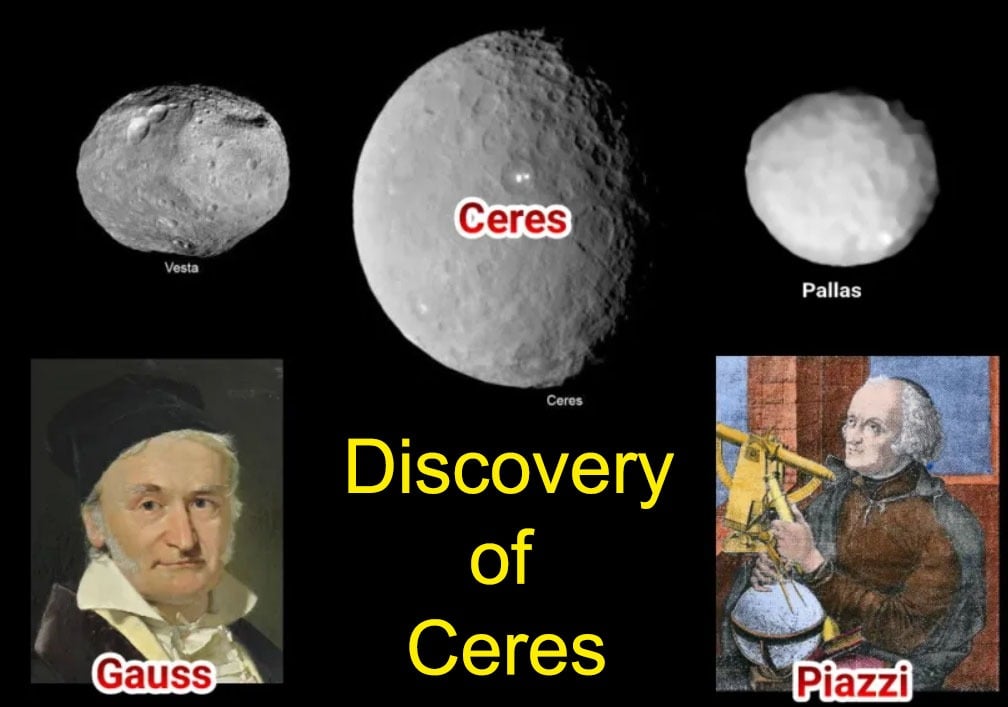
One member was Giuseppe Piazzi, an Italian astronomer from Sicily. He was a professor of mathematics and astronomy at the University of Palermo, and also held a position as a priest in the Church.
On January 1, 1801, while observing the night sky, Piazzi spotted a faint celestial object. At first, he thought it was a comet, but after further observation, he realized it was not.
However, Piazzi soon fell ill and had to stop observing. By the time he recovered and resumed work, the object was no longer visible—it had moved too close to the Sun and was lost in its glare. He informed the group, but none of the other members could locate it.
The story reached a 24-year-old mathematician and physicist named Carl Friedrich Gauss. Using only the limited data available, Gauss calculated its orbit mathematically and predicted its position.
Von Zach used Gauss’s calculations to search the sky—and successfully rediscovered the object.
Piazzi was given the honor of naming it. He called it Ceres Ferdinandea, after the Roman goddess of agriculture Ceres and King Ferdinand III of Sicily. Later, the name was shortened to simply Ceres.
However, astronomers were not fully satisfied, as Ceres turned out to be much smaller than expected. The search continued, leading to the discovery of Pallas (1802), Juno (1804), and Vesta (1807).
It became clear that these were not planets, but small celestial objects forming a separate group.
By 1815, the Celestial Police disbanded their search. Later research revealed that there is indeed an asteroid belt between Mars and Jupiter, containing an estimated 1–2 million asteroids.
Ceres, the first discovered asteroid, remains the largest one known, measuring about 940–950 km in diameter.
The story of Ceres’s discovery highlights the power of mathematics—without it, many astronomical discoveries, including Neptune, would not have been possible.
Carl Friedrich Gauss went on to become one of the greatest mathematicians of all time, with extraordinary contributions to electromagnetism among other fields.
From the atom to the cosmos—mathematics reigns everywhere.
Mathematics is the language of the Universe!
+917738890124
© 2025. All rights reserved.
Contact
Connect
Social Media
Coming Soon..