
Discovery of Neptune
7/16/20253 min read
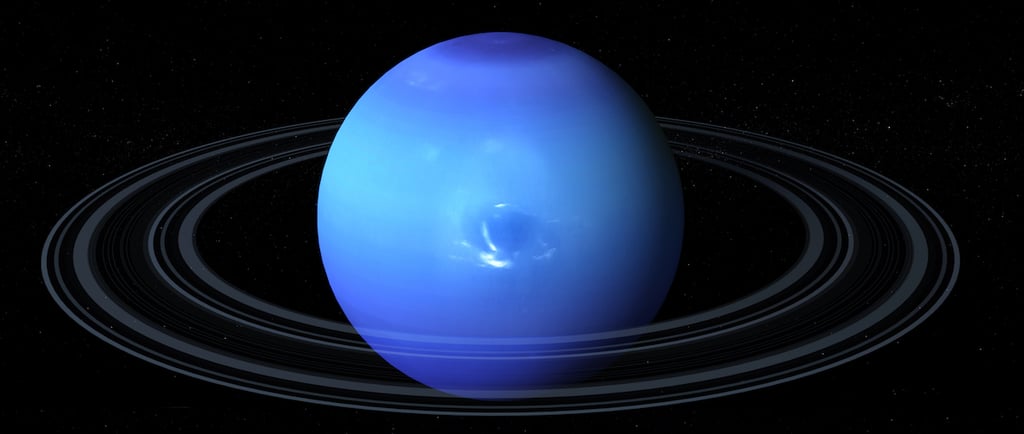
Discovery of Neptune
On 23–24 September 1846, the eighth planet of the Solar System was discovered—an event that now completes 176 years.
This was the first planet ever discovered beyond the range of human eyesight, found purely through the power of mathematics.
Its discovery highlighted the importance of mathematical predictions, and the story behind it is as fascinating as the discovery itself.
The story begins on 13 March 1781, when William Herschel discovered the planet Uranus.
Until then, only planets up to Saturn were known to humanity. Uranus was the first planet found using a telescope, and it is sometimes also called “Herschel” in his honor.
In 1841, an exceptionally talented astronomer, John Couch Adams, noticed irregularities in Uranus’s orbit.
He suspected that a planet beyond Uranus was causing these changes through its gravitational pull.
Adams, then a brilliant student at Cambridge University, became Senior Wrangler in 1843 and resolved to calculate the position of this unknown planet.
In September 1845, Adams completed his initial calculations and attempted to contact George Biddell Airy, the Astronomer Royal and director of the Royal Observatory at Greenwich.
His first attempt failed. He tried two more times, but Airy could not meet him.
Finally, Adams left a note at Airy’s door explaining his theory.
Two weeks later, Airy responded, asking for further mathematical clarification.
However, Adams never replied.
This proved to be a critical mistake—had he answered, Neptune might have been discovered earlier, and Adams might have received full credit.
With no follow-up, the search went dormant for a while.
Meanwhile, in June 1846, French astronomer Urbain Le Verrier published a paper suggesting the existence of a planet beyond Uranus.
He too was determined to find it but lacked precise star maps and doubted the accuracy of available telescopes, forcing him to pause his efforts.
Airy, reviewing the work of both Adams and Le Verrier, noticed that their predicted positions for the planet matched closely.
Convinced of the planet’s existence, he contacted his friend James Challis, professor of astronomy at Cambridge, urging him to begin the search immediately.
Using Cambridge’s powerful telescope, they began a systematic scan of the skies.
In fact, Challis unknowingly observed Neptune in August 1846 but failed to recognize it as a new planet.
During this time, Le Verrier reached out to Johann Galle at the Berlin Observatory.
On the night of 23 September 1846, Galle and his assistant Heinrich d’Arrest pointed a 9.6-inch refractor toward Le Verrier’s predicted location.
By midnight, they spotted a small disk-like object—only 1° away from Le Verrier’s predicted position.
That object was indeed Neptune—the first planet discovered by calculation before direct observation.
Interestingly, Galileo had actually recorded Neptune in December 1612, but he did not realize it was a new planet.
The discovery, however, sparked a heated debate—who deserved the credit?
Britain’s Adams, France’s Le Verrier, or Germany’s Challis?
Airy declared that Adams and Le Verrier should share the honor, though later historians continued to debate the matter.
As for the name, several suggestions were proposed. Initially, it was called “Le Verrier.”
Galle suggested “Janus,” but Le Verrier proposed “Neptune,” which was accepted.
In Roman mythology, Neptune was the god of the sea, equivalent to the Greek Poseidon.
The name suited the planet’s bluish color perfectly.
Neptune in Mumbai
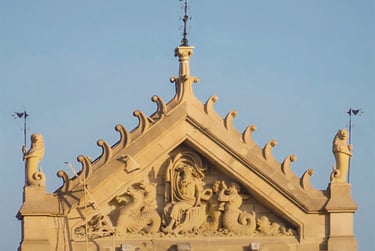
In South Mumbai’s Colaba area, at the Police Headquarters, there is a beautifully carved sculpture of Neptune.
It depicts Neptune traveling through the sea in his shell-shaped chariot, drawn by sea-horses, accompanied by his attendants.
The building originally housed the Royal Alfred Sailors’ Home, built in 1876 by the British for sailors arriving at Mumbai Port.
Given its connection to the sea, the Neptune sculpture was a fitting decorative choice.
The building was designed in the Gothic Revival style by the renowned architect Frederick Stevens.
If you ever visit the area, it’s worth seeing in person.
+917738890124
© 2025. All rights reserved.
Contact
Connect
Social Media
Coming Soon..